
Does learning a language help children understand other people’s perspectives?
A few weeks ago, I wrote about how learning a foreign language at school seemed to boost children’s creative thinking. That study followed the same group of children for a related question: does foreign language learning also help children get better at understanding what other people can and can’t see?
This matters more than it might first sound. Understanding that someone else has a different viewpoint from yours — what we call “perspective-taking” — is one of the building blocks of empathy, cooperation, and getting along with others.
How do you test something like that in a four-year-old?
We used a task called the director task. Here’s how it works: a child sits across a shelving unit from an adult (“the director”). Some objects on the shelf are visible to both of them; others are hidden from the director’s side, visible only to the child. When the director asks the child to “move the big duck,” and there are two big ducks — but the director can only see one of them — the child has to resist the temptation to grab the one that’s obvious to them, and instead pick the one the director is actually asking about, based on what the director can see.
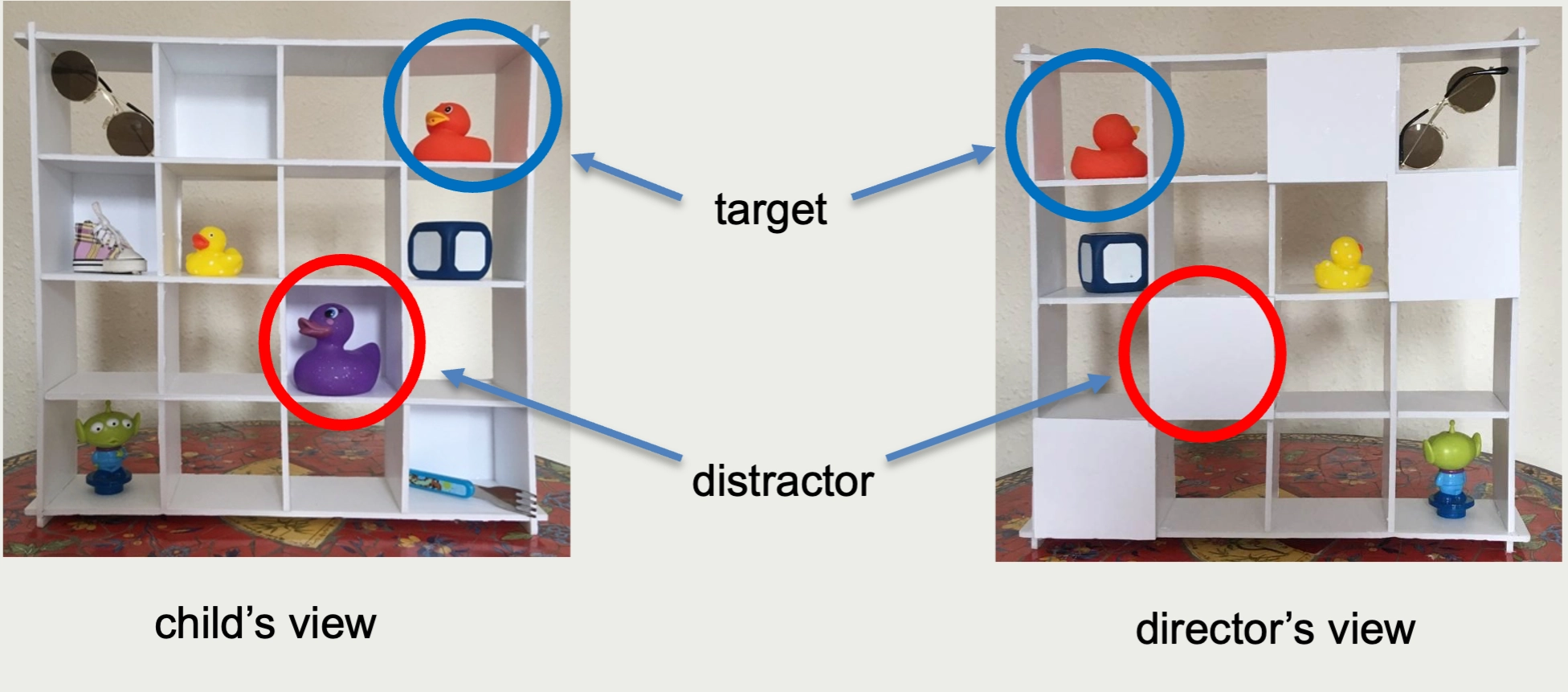
It’s a deceptively tricky task. Children naturally tend to be egocentric and reach for what’s most visible to themselves. Doing well means actively stepping into someone else’s point of view.
What we found
We tested 99 monolingual English-speaking four- and five-year-olds at the very start of their first school year, and again six months later. As in the creativity study, they were split into three groups: children at bilingual schools, children having weekly foreign language lessons, and a comparison group with no language provision at all.
The results were striking:
- Both the bilingual school children and the weekly language learners showed a clear improvement on the director task over the six months — and to a similar degree as each other.
- Children with no foreign language exposure showed no improvement at all over the same period.
- And it wasn’t because children with language lessons had simply sharpened their attention or vocabulary. We checked, and neither explained the improvement. Something about the language exposure itself, not general school progress, seems to be driving this.
What I find especially encouraging is that, unlike for creativity, even just one lesson a week was enough to make a measurable difference here. You didn’t need full bilingual immersion to see the benefit.
Why this matters
This adds to a growing body of work showing that bilingual children — those who grow up with two languages from birth — tend to be ahead of their monolingual peers in reading social and communicative cues. Our study suggests that you don’t need to grow up bilingual for this advantage to develop: learning a second language at school, even modestly, seems to accelerate the same skill.
And this isn’t a small thing. Earlier research has shown that children’s perspective-taking skills around age six predict how their teachers rate their social skills years later, at age ten. If language learning genuinely nudges this development along, even a weekly lesson could have a ripple effect on a child’s social confidence and relationships well beyond the language classroom.
Try this
In the classroom, look for natural opportunities — even outside language lessons — where children have to communicate with someone who doesn’t share their exact view of a situation: describing an object behind a screen, explaining a picture only they can see, or playing “guess what I’m thinking of” games. These small exercises in stepping outside one’s own viewpoint echo what seemed to drive the effect in our study.
For teachers and school leaders
This is genuine evidence that introducing a foreign language in the early years curriculum isn’t just a “nice extra” — it can support children’s wider social development too. If you’re making the case for protecting or expanding language provision in your school, even a modest weekly slot, this research is worth having in your back pocket. Early language teaching deserves a place in the curriculum not only for its own sake, but for the social skills it appears to nurture alongside it.
For parents
if your child is learning another language, even briefly each week, it’s worth knowing that the benefits may reach well beyond vocabulary — into how comfortably they read and respond to the people around them.
This post is based on our peer-reviewed study published in Bilingualism: Language and Cognition. You can read the full paper here: https://doi.org/10.1017/S1366728925000069